The Arbitration Clause That Only Bound One Side
An employer wrote a 'you must arbitrate, we can sue' clause — California's Supreme Court threw it out
What happened
Employees of Foundation Health Psychcare Services were required, as a condition of employment, to sign an agreement sending any future employment disputes to private arbitration instead of court. When they were terminated and alleged wrongful discharge and discrimination, they tried to sue. The employer moved to force the claims into arbitration under the clause they'd signed.
The case reached the Supreme Court of California, which used it to lay down the framework California courts still apply to arbitration agreements today.
The trap in the contract
The clause was a classic contract of adhesion — a standardized, take-it-or-leave-it term presented to a weaker party with no chance to negotiate. The court found it unconscionable on both required dimensions:
- Procedural unconscionability: It was imposed as a condition of employment, on a take-it-or-leave-it basis, by the party with all the bargaining power.
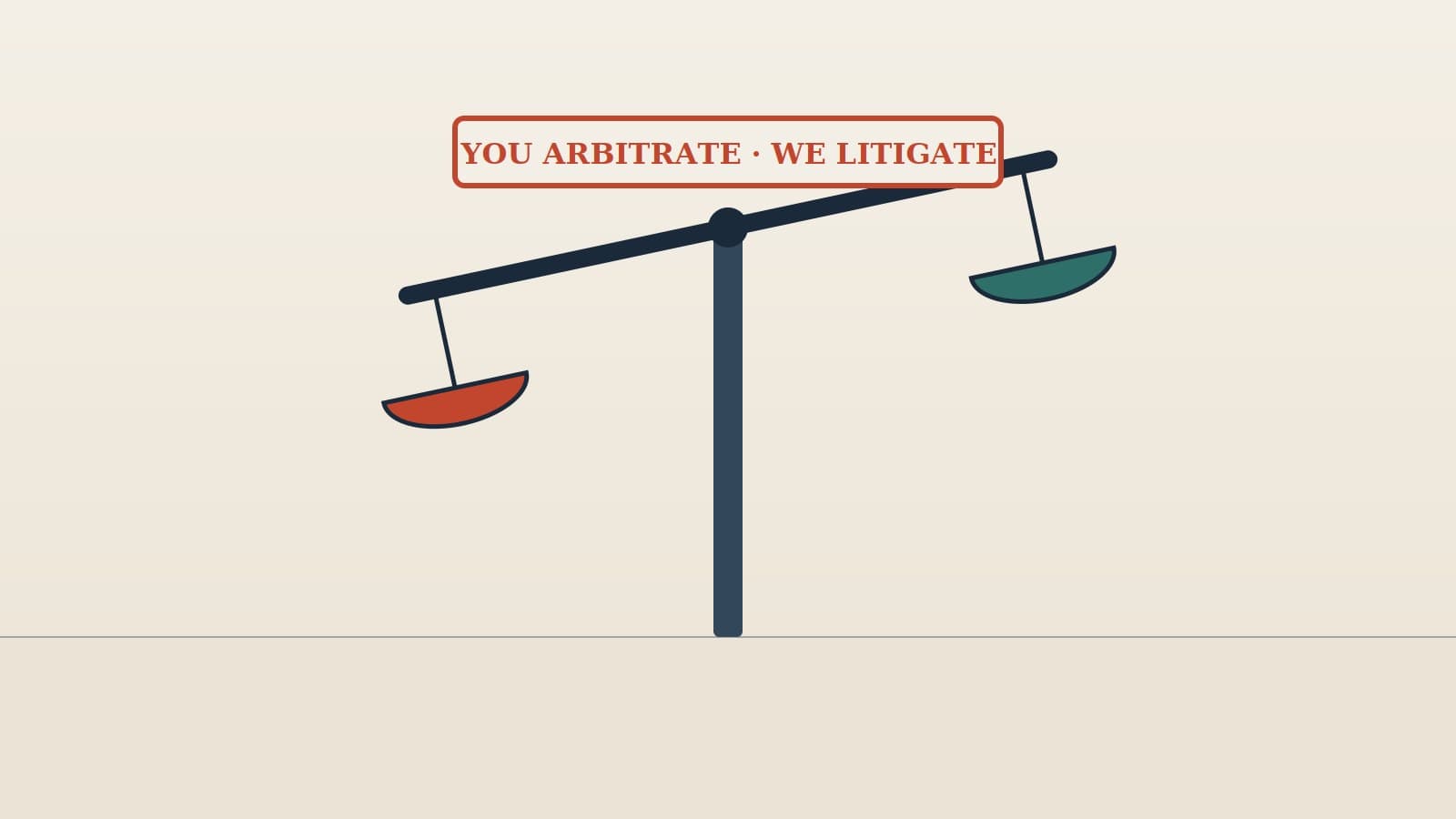
- Substantive unconscionability: The arbitration obligation ran in only one direction. Employees had to arbitrate the kinds of claims employees bring (like wrongful termination), while the employer effectively preserved its access to court for the claims it would more likely bring. The agreement also limited the damages an employee could recover — cutting off remedies they'd be entitled to under anti-discrimination law.
In other words: heads the company wins, tails the employee loses.
What the court did
The California Supreme Court held the arbitration agreement unenforceable. Along the way it set minimum requirements for a fair employment arbitration agreement (the "Armendariz factors"), including:
- a neutral arbitrator,
- adequate discovery,
- a written decision allowing limited review,
- all the remedies that would be available in court, and
- no requirement that the employee pay costs unique to arbitration.
Critically, the court refused to simply delete the bad parts and enforce the rest, because the agreement was so permeated with one-sidedness that fixing it would mean rewriting it.
Why this matters for predatory contracts today
Armendariz is one of the most cited consumer- and employee-protection decisions in the country. Its core idea — that a lack of mutuality plus stripped remedies equals unconscionability — still governs how California courts evaluate the fine-print arbitration clauses buried in employment, gym, app, and service agreements.
It also illustrates a key limit: under later law (e.g., the California Supreme Court's Ramirez decision), even a single unconscionable provision can doom an entire arbitration agreement when severing it would require rewriting the contract.
Red flags to check your own arbitration clause for
- "You arbitrate, we litigate." The clause forces you to arbitrate but lets the company sue you (often for "trade secrets" or "injunctive relief").
- Caps on your damages or shortened deadlines that are tougher than the law allows.
- You pay the arbitrator's fees — costs you'd never face in court.
- A class-action waiver that makes small claims economically impossible to pursue.
- It was a condition of getting hired/served, with no opportunity to negotiate.
This article is general legal information, not legal advice. Arbitration law involves a complex interaction between state unconscionability doctrine and the Federal Arbitration Act, and outcomes are fact-specific. Consult a licensed attorney about your particular clause.